The 5 Layer Cake
What it actually takes to run an AI — five layers stacked from the silicon chip to the app in your hands, explained with everyday examples.
You now know how AI produces an answer. But where does all that computing actually happen? When you type into Claude, an enormous machine springs into action behind the scenes. NVIDIA's CEO Jensen Huang describes it as a five-layer cake — five layers stacked on top of each other, each one depending on the one below it.
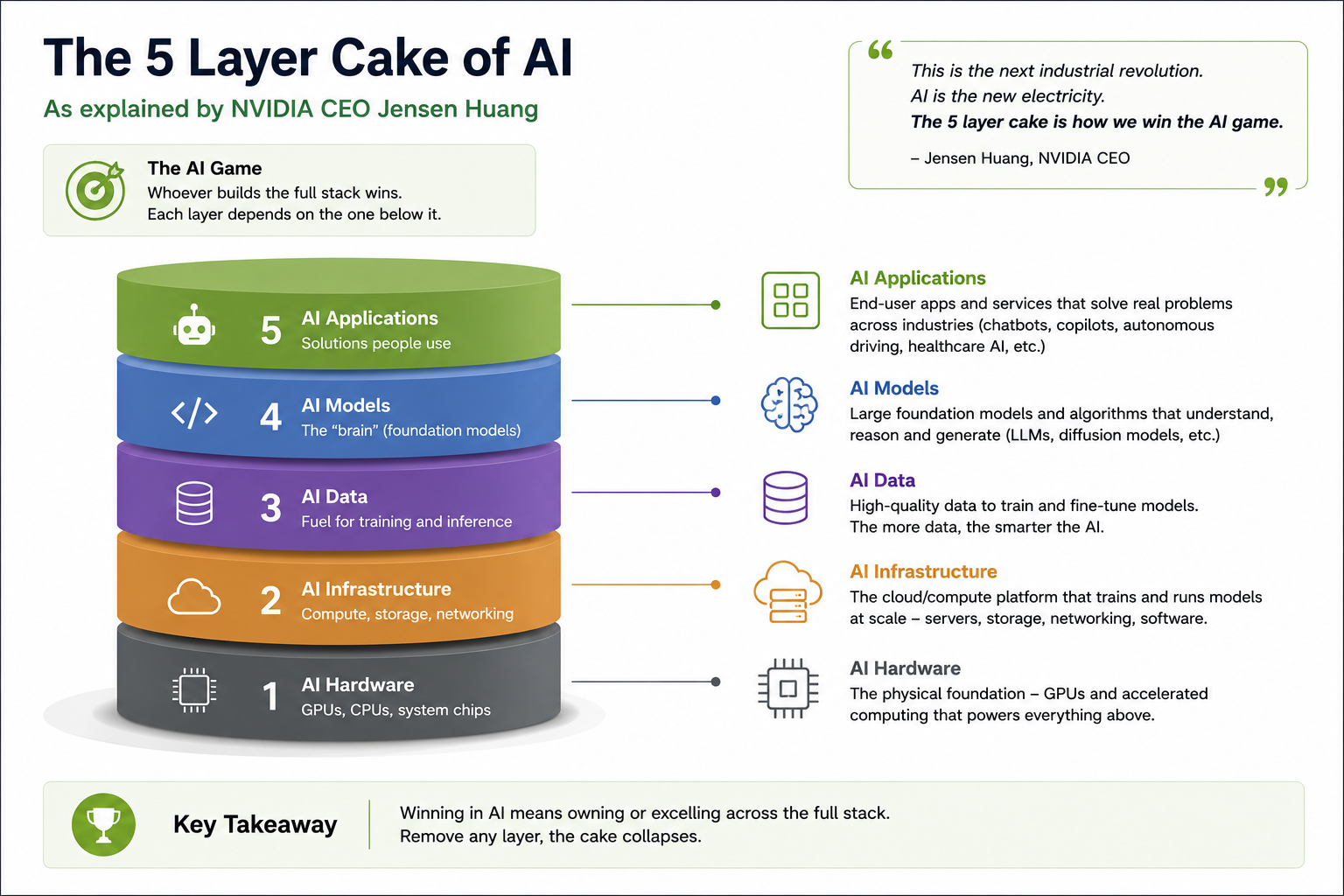
Think of it like ordering food at a restaurant. You (Layer 5) order a dish. A chef (Layer 4) cooks it. The chef needs recipes and ingredients (Layer 3), a kitchen with ovens and gas (Layer 2), and the building with electricity and water (Layer 1). You only ever see the dish — but four invisible layers made it possible.
Let's walk up the cake, from the bottom.
Layer 1 — AI Hardware
What it is: the physical chips that do the actual thinking. Not ordinary computer processors — special chips called GPUs (and TPUs) designed to do millions of tiny calculations at the same time. Remember from the last page that AI turns everything into numbers and multiplies them? These chips exist to multiply numbers, at staggering scale.
Who builds it: NVIDIA (the dominant maker), plus Google and Apple for their own chips.
Everyday example: this is the power station and the engine. A single top-end AI chip can cost more than a car, and a data centre may hold tens of thousands of them. When people say "AI is expensive," this is the biggest reason — the electricity bill alone for these chips runs into millions.
Layer 2 — AI Infrastructure
What it is: the cloud — giant warehouses full of those chips, kept cool, powered, networked, and rented out by the hour. Instead of every company buying its own chips, they rent computing power from a handful of cloud providers.
Who builds it: Amazon (AWS), Microsoft (Azure), and Google Cloud.
Everyday example: this is renting a fully-equipped commercial kitchen by the hour instead of building your own. A small bakery can't afford an industrial kitchen — so they rent time in a shared one. Anthropic, OpenAI, and your own future app all "rent the kitchen" from these cloud giants.
Layer 3 — AI Data
What it is: the information the AI learned from — books, websites, code, articles, conversations. Before an AI can predict the next word, it has to read a huge amount of human writing to learn the patterns. The quality and breadth of this data decides how good the model becomes.
Who builds it: researchers and companies who collect, clean, and organise enormous datasets.
Everyday example: this is the recipes and ingredients the chef learned from. A chef who trained on thousands of recipes cooks better than one who saw a handful. An AI trained on more (and better) text predicts better. This is also why AI has a training cutoff — it only "read" up to a certain date, so it doesn't know what happened after that. (You'll see this vividly in the Ghajini analogy on the next page.)
Layer 4 — AI Models
What it is: the "brain" itself — the trained model that takes your tokens and predicts the next word. This is the actual artificial intelligence: GPT (from OpenAI), Claude (from Anthropic), Gemini (from Google). Building one of these costs hundreds of millions of dollars in chips, cloud time, and data.
Who builds it: OpenAI, Anthropic, Google — a small number of very well-funded labs.
Everyday example: this is the trained chef. Years of learning are now baked into one person who can cook on demand. You don't see the training — you just give an order and get a dish. Different chefs have different strengths: one is faster, one is more careful, one is cheaper.
Layer 5 — AI Applications
What it is: the tools real people use — ChatGPT, Claude, Gemini, and the app you are going to build. An application wraps a model (Layer 4) in a friendly interface, adds memory, tools, and rules, and points it at a real problem.
Who builds it: anyone — including you, after this course.
Everyday example: this is the restaurant — the menu, the table, the waiter, the experience. The chef (model) is essential, but customers come for the restaurant, not the raw chef. Your School ERP and your personal project both live here: you take a powerful model and turn it into something a real person opens and uses.
The Whole Cake in One Table
| Layer | What it is | Everyday example | Who builds it |
|---|---|---|---|
| 5 — Applications | The tools people open and use | The restaurant | You, ChatGPT, Claude |
| 4 — Models | The trained "brain" | The trained chef | OpenAI, Anthropic, Google |
| 3 — Data | What the AI learned from | The recipes learned | Researchers, companies |
| 2 — Infrastructure | Rented cloud computing | The rented kitchen | AWS, Azure, Google Cloud |
| 1 — Hardware | The physical AI chips | The power station + engine | NVIDIA, Google, Apple |
Which layer of the AI cake will YOU build on in this course?
Before you move on — can you do all of this?
Click each item you're confident about. Bring the unchecked ones to your next session.
I can name the 5 layers from hardware up to applications
I understand why AI costs money — the hardware and cloud layers are genuinely expensive
I understand "training cutoff" comes from the Data layer — the AI only read up to a certain date
I know I build at Layer 5, and don't need to understand Layers 1–4 to do it
Next: Ingredients of AI — the building blocks that decide the quality of every answer, explained through the Ghajini analogy.